“When surveillance becomes effortless, totalitarianism becomes the default.”
The data center coming to Holly Springs is a surveillance machine
The CEO behind the push describes data centers as essential infrastructure for analyzing terabytes of surveillance footage.
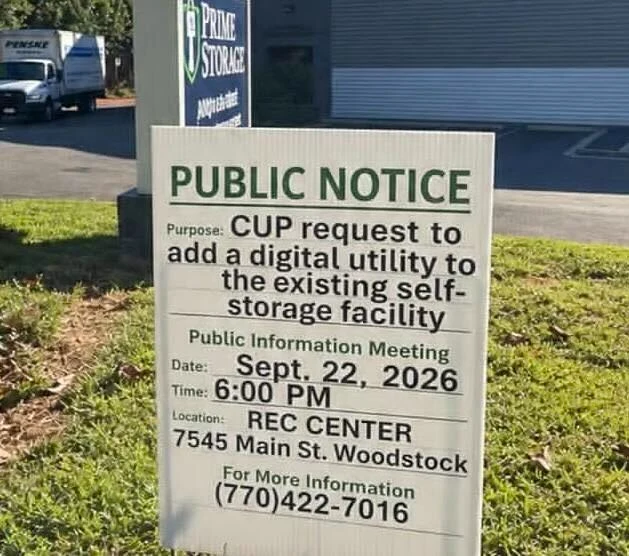
The City of Holly Springs is weighing a conditional use permit that would convert part of a Prime Storage facility into a "digital utility." According to the permit file, which we obtained through an open records request, the culprit is The Edge: Prime Storage's initiative to convert its buildings into AI data centers. The Edge's national map already lists this site as "GA11", and forecasts 10 megawatts of capacity.
The average person has been given every reason to oppose the militaristic AI data center rush. From the gloomy predictions of tech oligarchs, that AI may very well kill everyone or destroy the labor force (which it stole the collective work of); to their wretched infrastructure, acting as acoustic weapons that force local residents to flee, reviving the fossil fuel industry that's intent on boiling the planet, and draining local water supplies during mass droughts; to their current specialization of generating sexually explicit images of children, murdering them overseas, convincing teens to commit suicide, destroying the education system, and flooding the social internet with slop... there is a lot to hate.
Others have and will analyze the various horrors of AI data centers as they continue to be pushed on communities against our consent. So why are we, an anti-surveillance group, writing about it?
The CEO behind this data center loves mass surveillance

Emmanuel Daniel, the CEO of Alosanar, the data center design firm partnering with Prime Storage, recently spoke about demand for AI at a webinar hosted by the Potomac Institute for Policy Studies:
"If you look at ISR—Intelligence, Surveillance, and Reconnaissance—where you have drones, satellites, ground sensors [...] we are talking about generating a petabyte of data per day. [...] You want to use AI? You have to be able to generate that power. If you don't have that power, all the ISR data that is coming in is going to be impossible for an organization [...] to interpret."
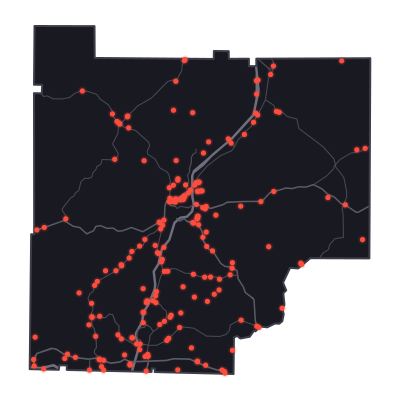
Daniel speaks to a common belief among tech CEOs that the primary use case for new data centers is to provide the power and hardware needed to turn AI into the ultimate surveillance agent. The bottleneck for modern surveillance isn't cameras: Flock churns them out for dirt cheap (which is, of course, why they're so easily hacked). Cherokee County has 111 Flock cameras, 622 private cameras with police access, two drones, and nowhere near enough employees to watch and analyze the feeds from all of them. AI removes that limitation. With the power and hardware of a local data center, AI becomes an omnipresent, hyper-vigilant watchdog on every street corner. When combined with techniques such as facial recognition, gait recognition, and eye tracking, it amounts to an erasure of privacy and a level of power that no one should be able to wield.
The application, too, loves surveillance
When asked to explain what services the AI data center would provide, Prime Storage's application (PDF) answers that the infrastructure "supports essential uses such as health care, public safety response, and business operations." When asked why this specific location was chosen, it cites proximity to "governments that increasingly rely upon fast response times for emergency management services." And when asked whether the local market actually demands this, it says The Edge "concluded there is a significant demand for this technology in the local market from local governments, medical providers and high-tech businesses."
"Local government" thus seems to be a common theme (the application's other potential customers are more far-fetched: hospitals tend not to use these AI services due to patient confidentiality concerns, and no local high-tech businesses are listed as customers). The application also repeatedly uses euphemisms for surveillance, such as "public safety" and "emergency management". Whether Cherokee County's Real-Time Crime Center, a surveillance nexus maintained by the Sheriff's Office, is a planned customer is unconfirmed. We have asked Sheriff Reynolds directly whether this is the case, and hope to have an answer ready before the public information meeting.
Marietta fought this battle, and won concessions
In July, Prime Storage applied to convert 10 acres of its Powers Ferry Place self-storage facility in Marietta into an 18-megawatt data center. It asked the city to permit a "regional mission critical digital infrastructure" use.
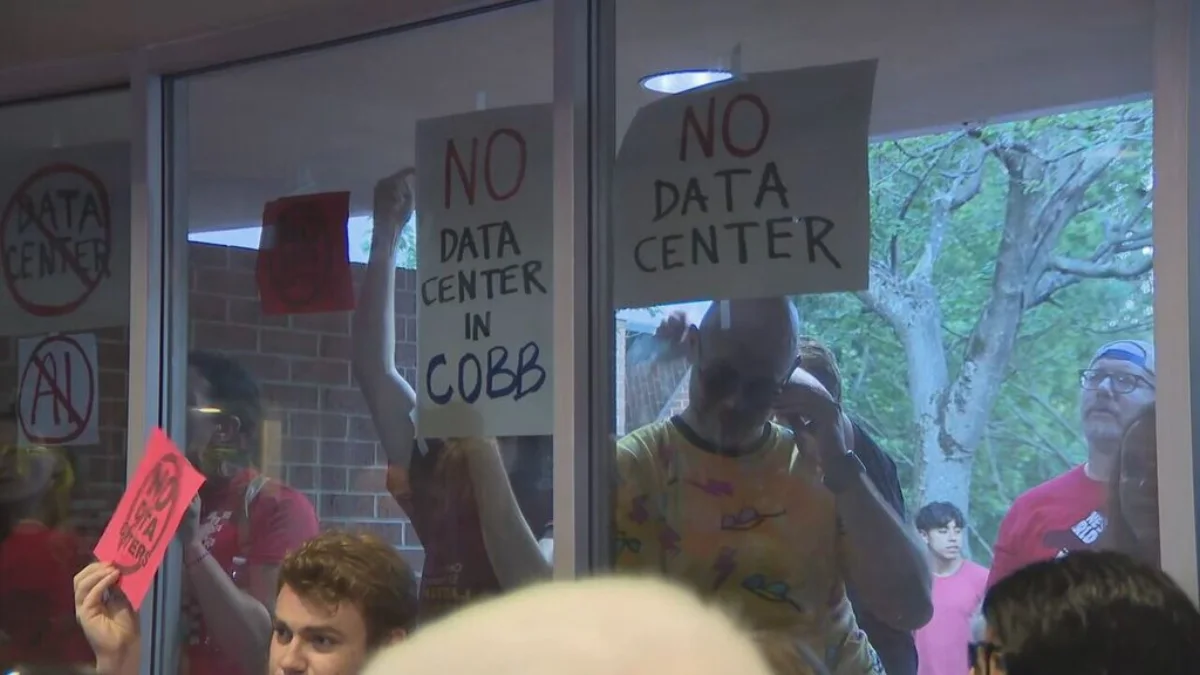
Hundreds of residents packed City Hall. The council tabled the vote and passed a six-month moratorium on new data center applications (which did not apply to Prime Storage's, as it had already been filed). On August 12th, in spite of public outcry at another packed hearing, the council approved it five to two.
Despite the council's indefensible decision, the opposition forced them to apply conditions to the approval: independent sound studies, continuous monitors, silencers on coolers and generators, no use of the city's water or wastewater systems. Most importantly, Prime Storage agreed not to build another data center at its other Marietta facilities. That's 48 megawatts of planned capacity, cancelled.
Throughout this, Cherokee County watched and learned. On July 22nd, the Board of Commissioners unanimously approved a 30-day moratorium on data centers, and on August 18th extended it to 180 days after a packed public hearing.
Unfortunately, that moratorium only covers unincorporated Cherokee County. The loophole Prime Storage found is to target incorporated Holly Springs: a city whose code has no definition for, and thus no protections from, a data center.
What you can do
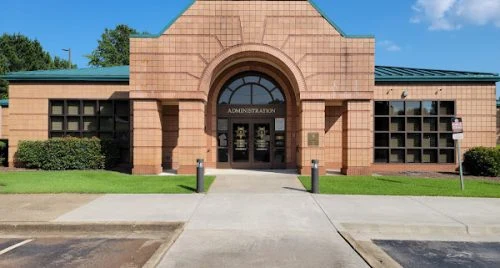
Join us at the public information meeting on Tuesday, September 22nd, at 6 PM, at the Rec Center, 7545 Main Street, Woodstock. The more residents that pack that room, the stronger our opposition will be.
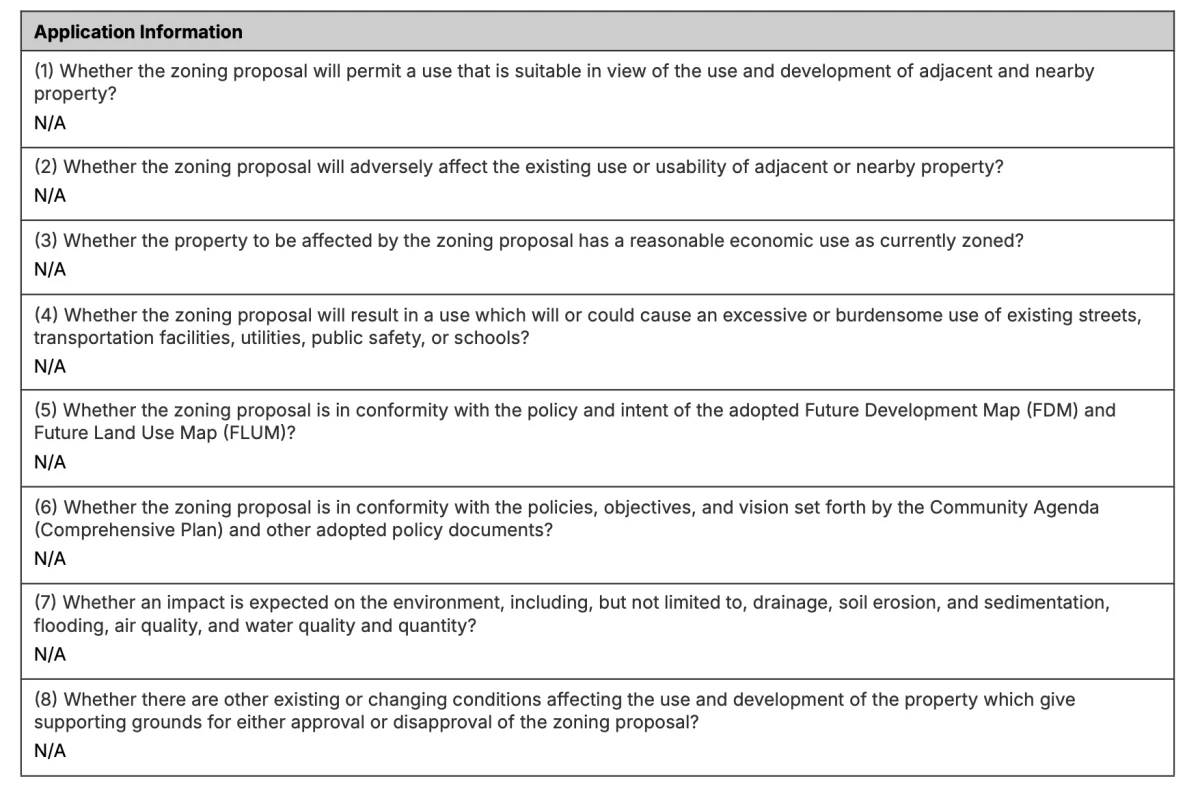
Read the application. We requested the permit file from the city, which you can download here (PDF, 11 pages). If you're coming to the meeting, print it if you can. There's plenty in there to ask about, from their ill-defined "sound study" (When will it be done? What frequencies will it test for? Who will it be published to?), to how much power they plan to draw, to all the "N/A's" on ecological questions.
Write to the Holly Springs City Council. They have direct control over whether this data center is allowed in their jurisdiction. See our page on Holly Springs for the contact information of the mayor and city council, and make your voice heard.
Tell your neighbors, and follow developments online. We and similar organizations intend to be very loud about this. Consistent, widespread engagement is the best way to show those in power just how much the public opposes a data center at their doorstep.